

A robot enters your hospital room. It can follow instructions, navigate the halls and perform the task it was built for. But can it recognize when you need something else? Who answers if it makes a mistake? And how would anyone know whether its presence helps you get better?
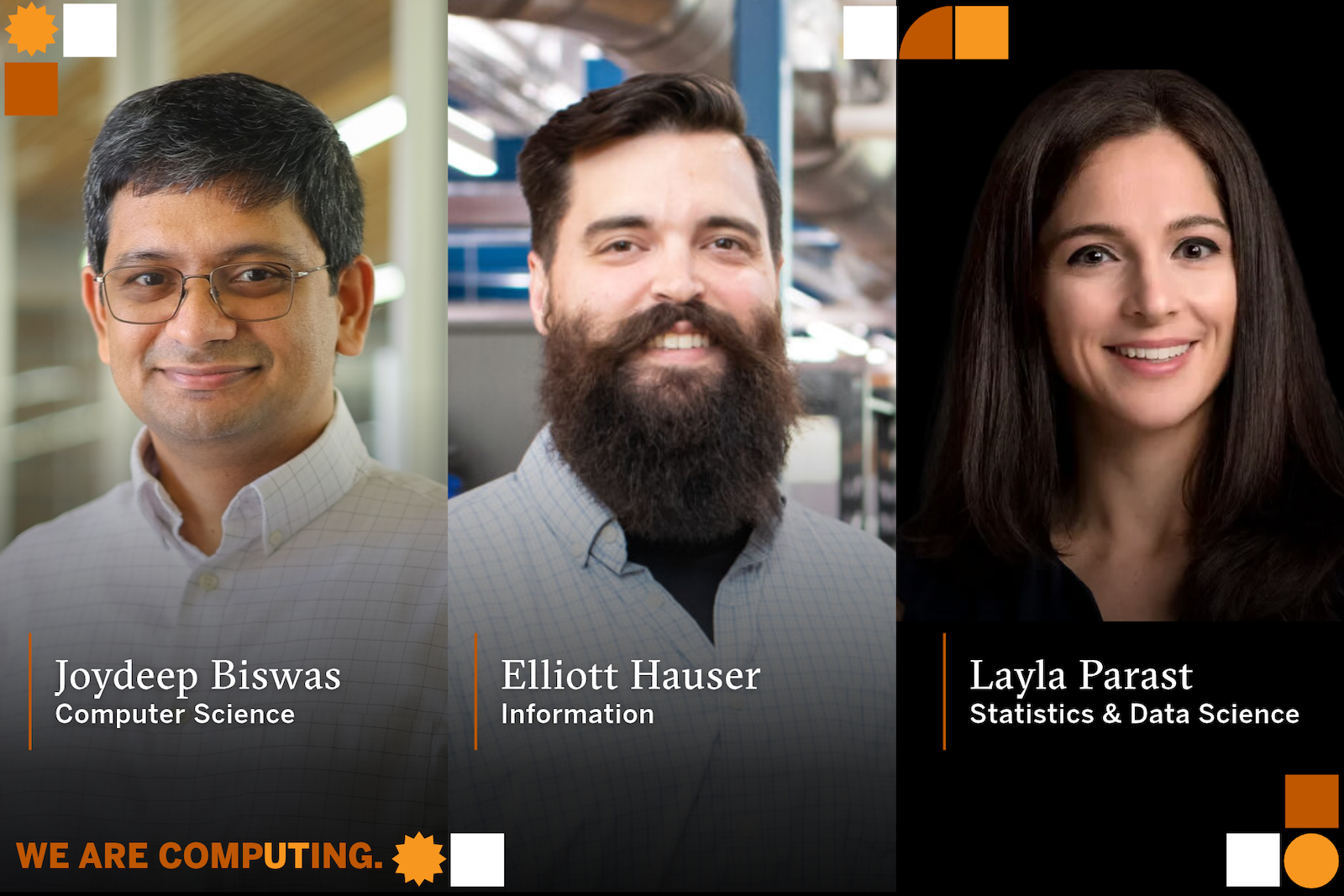
In the first installment of Where Disciplines Meet, we explored what Computer Science, Information, and Statistics and Data Science each bring to the School of Computing. This time, researchers from the three disciplines take on one question together: how can AI-powered robots earn our trust in healthcare?
Computer Science: Building Machines That Know What's Needed of Them
For Joydeep Biswas, associate professor in the Department of Computer Science and director of the NSF Center for Human and Robot Co-Adaptation, the road to trustworthy assistive robots starts with a humbling admission: we have mostly built machines for tasks, and people need far more than tasks.
"We've been working a lot on AI-powered robots doing specific things, in specific ways, for an assumed group of people," Biswas said. "The reality is that people will want them to do a wider set of things than we thought of, and in ways designers might not have anticipated. And people aren't static."
Autonomous vehicles offer a preview of the gap. A robotaxi can miss the rider waving a few feet from the pin, which is fixable. The deeper problem lies off script. "There is nothing in the app that says, help me move this tree after a storm. If I fall on the side of the road and wave to a passing autonomous taxi, "please take me to the hospital”, it will ignore you. This is what I mean by doing things people need and care about, not just the tasks they were prescribed."
Giving a robot that judgment is the field’s hardest open problem. “Understanding that you need to do something is extremely non-trivial,” he said. Capable robot vacuums can avoid obstacles, but realizing if the obstacle is a fallen human that they may need medical assistance, is much harder. That judgment requires understanding context beyond what sensors detect. “Making these connections is not trivial. We need computationally efficient algorithms that can consider arbitrary open-ended concepts in the real world.”
Testing is just as hard. “It’s very hard to do these studies with real users in real environments,” he said. “So, there’s a big question: do the algorithms we’re building to interact with people actually work with real people, or are we missing something?” The NSF center’s approach will be to build understanding incrementally, exploring tasks in settings such as public spaces and everyday human environments while working with potential users. The goal is to learn whether algorithms developed for human interaction actually serve people in everyday environments.
Trust also depends on who decides what the robot does. “A company alone should not decide what a robot is or does. It needs to engage with the people who will use it,” he said. “We don’t assume robots will be useful in the ways we expect. We want to work with potential users in their environments, alongside other stakeholders, to ensure that what we develop aligns with their values and needs.”
School of Information: Earning a Place in the Room
If computer science asks what a robot can do, Elliott Hauser, assistant professor in the Department of Information and co-lead of the Living and Working with Robots project, asks what it means for a robot to be there at all.
In this project, Hauser studied people meeting a robot on a familiar sidewalk. What separated the unbothered from the unsettled was often small. "Our participants who had a common sense understanding of what a robot might be doing here were able to move on," he said. "The people who were concerned were worrying about what this robot could be doing that would be dangerous."
That points to a design problem. "If I walk into a room, I'm accountable to that group to tell them why I'm there. That accountability can be operationalized as an engineering or design challenge." In healthcare, that accountability can be delegated, as with a radiologist we never meet but who answers for reading our film. "With an intelligent agent, the accountability is currently ambiguous. What do I do if this goes haywire?"
Our imagination makes this harder. "From Rosie the Robot to Data from Star Trek, we always imagine a robot as an individual that might replace someone," Hauser said, "but the interactions we have are much more often with a team. Care is the same. It's very important that the nurse remain accountable to the patient. The robot might be well suited to provide many of the other things, but in many cases it shouldn't be patient facing."
But if people have so readily welcomed chatbots into their lives, why wouldn’t robots follow the same path? Chat has benefited from decades of texting, which made meaningful conversation without a physical presence familiar. People already extend social standing to AI. “I know it’s not a human, but I still say please to ChatGPT,” Hauser said. “Some people even say they trust it or feel understood by it, as they would by another person. But a robot moving through physical space is less familiar. We just don’t have that norm yet.”
So, his forecast is patient. "I know that sounds like a cop-out, but social norms don't develop randomly. They develop over time through experience." He imagines patients first accepting a robot analyzing blood samples behind the scenes, much as they trust a lab technician they never meet. These indirect interactions offer a lower-risk starting point for building trust.
He is also candid that his research is built to allow an unwelcome result. "The studies are set up so the answer might be, ‘robots shouldn't be used, or not yet’. Rolling out a technology before it's mature enough to provide value is exactly the thing we want to avoid as a field."
Statistics and Data Science: Compared to What, Measured How, and in Whom?
Layla Parast, associate professor in the Department of Statistics and Data Science, points to her father’s hospital stay after a cardiac arrest as an example of how AI can support patient care. She used ChatGPT to better understand his medications and prepare questions for his care team. When it flagged a possible redundancy, she raised the concern with a nurse, who checked with the doctor. The medication was withdrawn.
“I am grateful that the nurse was willing to be questioned, the doctor was willing to reconsider, and that I had AI as a second set of eyes,” Parast said. “That is the only version of AI in healthcare I can imagine trusting right now: one that adds a check rather than replacing one.”
For a statistician, trust comes down to three questions we already ask of any new treatment:
- Compared to what? Researchers must define the comparison and what counts as equivalent performance before a study begins. “Failing to find a difference isn’t the same as showing equivalence,” Parast said.
- Measured how? Speed and accuracy matter only if they reliably reflect better outcomes for patients. “If someone tells me a robot is 98% accurate, I want to ask: accurate at what, and does it translate into a patient going home healthier?”
- In whom? Results from one group of patients may not apply to another. “I would want to know who it was tested on, and whether they look like the patient in front of it,” Parast said.
These questions show how statistics connects the work of the three departments, helping determine whether a robot’s technical performance and its role in patient care translate into better health outcomes. "I feel like we come in right in the middle," Parast said. "The hard outcomes would come from computer science. The human outcomes, I think we would learn from information. But then, are those really the outcomes that would measure long-term patient health? That is where we come in, designing a study to ensure that the effects we see on the outcomes we measure are truly representative of the effects we care about."
So, what would it actually take to prove trust, rather than just hope for it? Parast points to a model her field already has: drug trials, not device approval. "Device regulation isn’t how I’d want AI-powered robots evaluated. Instead, I’d model it on drug approval, which is a phased process, like a phase two trial before phase three. It costs more time and money, but it means a failed phase two doesn’t lead straight into a huge phase three. That’s the kind of staged, evidence-based standard I think these systems should meet."
She sees the department's longest impact in the classroom, especially with pre-med students. "We train them to ask: how much uncertainty is in this estimate? Where might this be biased? What does this number actually mean, and what doesn't it mean?"
Back in the Room
Imagine yourself in that hospital bed as a robot approaches the door. What would you want it to do, and how would you want it to know? Would you want it to notice what you hadn’t thought to ask for, or would that feel like being watched? Would you prefer it to work out of sight while a nurse stays at your bedside? What would earn your trust: a clinical trial, a track record, or seeing someone you already trust work beside it?
These questions bring the School of Computing’s three disciplines together. Computer Science explores how machines can recognize what people need. Information examines how they fit into our lives. Statistics and Data Science tests whether they make those lives better. Your answers help shape what comes next.
What becomes possible when disciplines come together? Explore research across UT Austin’s School of Computing.