

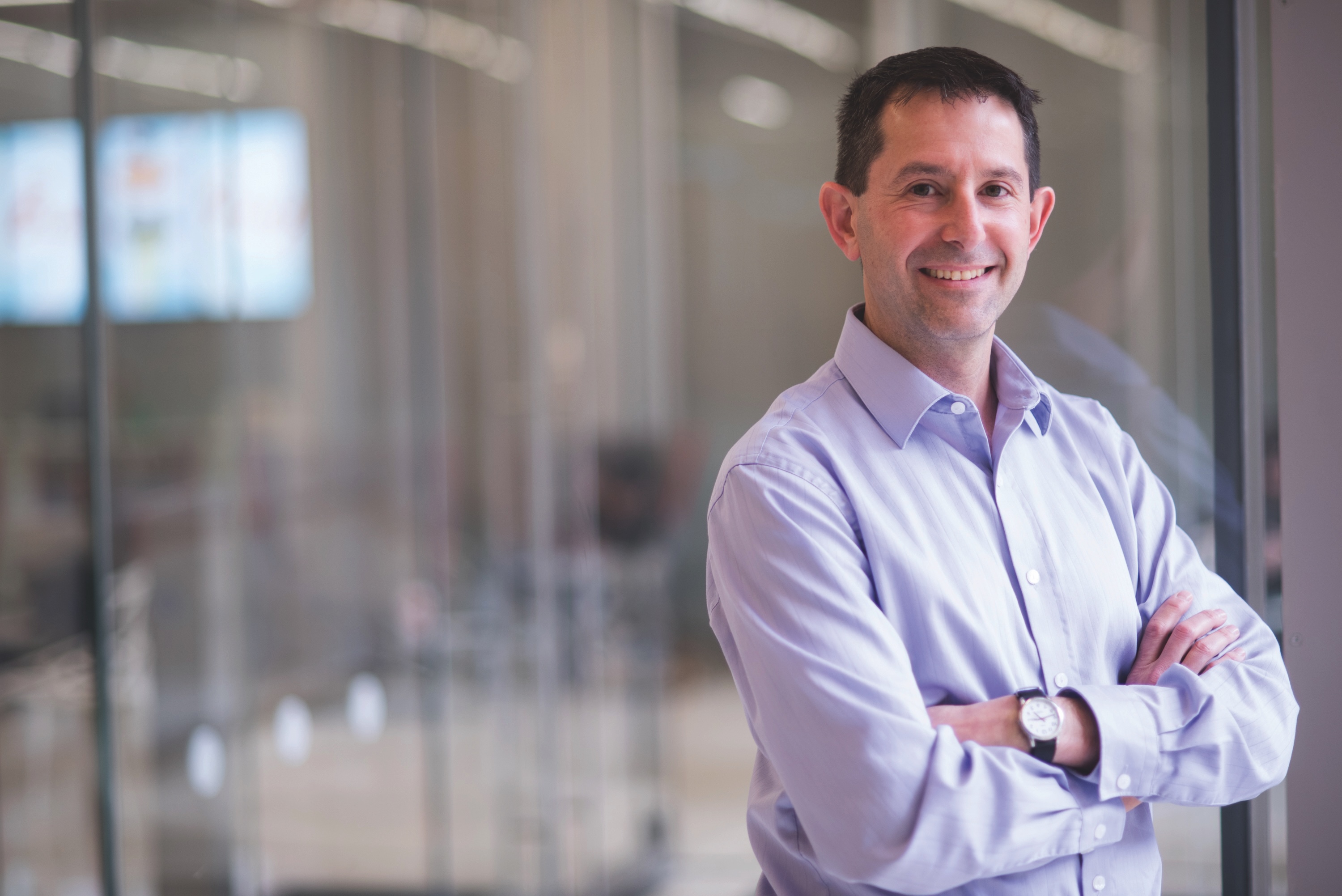
Peter Stone has spent more than three decades working in artificial intelligence, machine learning and robotics. Yet when he describes what has sustained his interest across a period of extraordinary technological change, he returns to a question that is more fundamental than any particular system or breakthrough: What is intelligence?
For Stone, head of The University of Texas at Austin’s School of Computing and a professor of computer science, that question belongs among the great unresolved mysteries of human existence. “There are three big questions I think of for our time,” he says. “How did the universe start? How did life on Earth get started? And what is the nature of intelligence?”
It is a question that reaches well beyond computer science. Psychologists study human behavior, neuroscientists examine the physical workings of the brain, and philosophers ask what it means to call a person, animal or machine intelligent. Computer scientists approach the problem from another direction: by attempting to create systems capable of doing things that, if performed by a person, would be considered intelligent.
That effort has already produced technologies that are changing education, research and everyday life. But Stone does not see recent advances as evidence that the underlying mystery has been solved. If anything, they have revealed how much remains unknown. His perspective on the future is therefore neither uncritical optimism nor reflexive alarm. It is grounded in curiosity about what machines can become, humility about what we still do not understand and a conviction that society must actively shape how these technologies are used.
A Simple Problem With a Profound Implication
Stone’s interest in intelligence began when he was in high school, during a career-day visit to a university near his hometown of Buffalo, New York. A professor studying computer vision presented what appeared to be an elementary problem. A young child could look at a circle, square or triangle drawn on a page and immediately identify it. At the time, a computer could not.
Today, image-recognition systems perform such tasks routinely, making it easy to overlook how significant that challenge once seemed. For Stone, however, the example revealed something profound: abilities that feel effortless to people can depend on forms of intelligence that are remarkably difficult to describe, much less reproduce.
“It was impressed upon me that there’s actually much more going on than we feel as people,” he says. “You appreciate that when you try to build an algorithm or a machine to do the same thing.”
That realization became the intellectual thread running through his career. Building an intelligent system is not necessarily an attempt to recreate the human mind in silicon. It can also function as a method of inquiry, forcing researchers to make their assumptions explicit and breaking seemingly natural abilities into processes that can be studied, tested and improved.
The results have been remarkable, but Stone cautions against mistaking progress in particular forms of AI for a complete theory of intelligence. “We still don’t have all of the keys to intelligence,” he says. “It’s not just a matter of putting in more data and more computation, and suddenly you’re going to solve all of human intelligence.”
This is one of the paradoxes that continues to motivate him. The field’s successes have not necessarily brought researchers closer to a simple, unified answer. Instead, each advance has exposed new layers of complexity. “The more we learn and the more progress we make,” he says, “the more we understand how far away we are from building machines that can really do everything people can.”
When Technology Begins to Amplify Thought
Stone places AI within a much longer history of people developing tools that extend their capabilities. Humans first built machines to supplement physical strength, gradually reducing the muscle power required to transport materials, manufacture goods or cultivate land. Artificial intelligence extends that impulse into the cognitive realm.
“Just as we have historically offloaded the need to use our own muscles for physical tasks, we’re now asking whether there are ways to offload or augment brain power with automated processes,” he says.
Whether AI ultimately offloads human thought or augments it is not simply a technical question. It depends on how people incorporate these systems into their lives. Stone sees that distinction playing out with particular clarity in education, where students now have access to tools capable of explaining concepts, answering questions and producing finished work within seconds.
Some students are using AI as a highly responsive tutor. They can ask questions whenever they encounter difficulty, explore a concept from multiple angles and receive support that previously might have been limited to a short conversation during office hours. Others are using the same technology to bypass the intellectual effort through which learning occurs.
“We’re seeing some students ace the same exams we gave three years ago and do much better than students used to,” Stone says. “Then there’s a population of students doing much worse.”
The challenge is not to pretend these tools can be removed from education, but to help students use them in ways that deepen rather than replace thought. Stone compares the moment to earlier debates about calculators in elementary classrooms, television in the home and, more recently, social media. Each technology required educators and parents to reconsider what young people needed to learn, what could responsibly be delegated to a machine and which human capabilities remained essential.
He is optimistic that society will become more sophisticated in answering those questions, though he does not expect the risks to disappear. “It will always be possible to misuse AI tools and engage in cognitive offloading: letting the AI give you the answer, not taking responsibility for it and not trying to learn for yourself,” he says. “But I think, as parents and teachers, we’ll become more sophisticated about how to raise genuine, good human beings in concert with these tools.”
Searching for AI’s Seat Belts and Airbags
Popular culture has long imagined artificial intelligence through opposing extremes. In one version, intelligent machines become uncontrollable and threaten the people who created them. In the other, helpful robots relieve humanity of work and deliver a life of effortless abundance.
“You have The Terminator and Blade Runner, and then you have The Jetsons and Rosie the Robot,” Stone says. “It has typically been either an all-bad narrative or an all-good narrative.”
Stone is encouraged that the public conversation has become more nuanced. Like nearly every transformative technology, AI is likely to produce genuine benefits, meaningful disruption and unforeseen consequences at the same time. The important question is not whether it is inherently good or bad, but whether institutions and individuals can develop the safeguards, standards and habits needed to make its benefits substantially outweigh its costs.
History offers useful parallels. When electricity was first introduced into homes, builders did not yet know how to wire them safely, and electrical fires were common. The response was not to abandon electricity, but to develop safety standards. Automobiles delivered unprecedented mobility while also causing deaths, leading over time to seat belts, airbags, traffic laws and safer road systems.
AI presents a comparable challenge, but on a dramatically compressed timeline. “It took somewhere between 50 and 70 years to go from the Model T to 100 million cars on the road,” Stone says. “ChatGPT reached 100 million users in about a month. We haven’t had the same time to figure out the equivalent of seat belts and airbags for AI models.”
That does not mean public concerns should be dismissed as resistance to progress. Stone views questions about employment, education, misinformation and the energy and water consumed by data centers as legitimate responses to a technology capable of reshaping society. He is also careful to distinguish the current generation of resource-intensive AI systems from artificial intelligence as a broader field. Today’s models require enormous amounts of computing power because of the particular methods on which they are built. Future approaches may be considerably more efficient.
“One of the most exciting open areas in artificial intelligence is whether we can discover algorithms that achieve the same things as current AI models with orders of magnitude less data, training and power,” he says.
The Future is Ours to Shape
Stone believes intelligent machines could ultimately represent a societal change comparable to electricity, long-distance communication or the internet. But the direction of that change is not predetermined by technology. It will depend on the choices made by researchers, companies, policymakers, educators and the people who use it.
“We can’t say with 100% confidence that it’s all going to be good for society,” he says. “We have to look at both the risks and the rewards.”
That perspective also reflects the purpose of the School of Computing, which brings together Computer Science, Statistics and Data Science and Information. Each discipline approaches Stone’s central question from a different but essential direction: computer scientists build systems that perceive, learn and act; statisticians and data scientists examine how reliable knowledge can be drawn from data; and information researchers study how intelligence is understood, experienced and shaped by people and society.
Together, the three departments can explore not only what intelligence is and how it might be created, but also how intelligent systems can be evaluated, governed and designed to serve human needs. After more than 30 years, the question that first drew Stone to computer science remains unanswered. Now, as head of the School of Computing, he is helping build an interdisciplinary community equipped to pursue it.
Learn how Peter Stone’s vision brings computer science, statistics and data science, and information together at UT Austin’s School of Computing.